

CSF Radiators Charge Air “Super” Intake Manifold Black Finish (Supra A90 A91 20+/2, 3, 4 Series B58 Gen 2) – Black Certified
Original price was: $8,369.00.$3,347.60Current price is: $3,347.60.
Description
All the Features You Need to Push the Limits
CSF is proud to announce its most advanced cooling system to date the new Charge-Air Cooler Manifold for A90/A91 Toyota Supra and BMW G-Series (B58).
With well over 1,500 hours of design, prototype development, machining, and testing, CSF, along with partners VF Engineering (USA) and Custom Plenum Creations (Australia), has now brought a state-of-the-art CNC machined, high-performance Charge-Air Cooler Manifold to the B58 platform for Mk5 Supra and BMW models. This product solves what has been commonly known as a weak link of an otherwise impressive new engine platform.
With the larger and more efficient water-to-air intercooler performance, lower pressure drop across the system, included fuel rail, kit for top feed port injection, and several other industry-leading features, the CSF Super Manifold will allow B58 owners to maximize the performance of their vehicles and push the limits further than what has been previously possible with this new platform.
CSFs Creates the Missing Link to Maximum B58 Performance
The newer 2nd gen B58 engine, found in the Mk5 Supra, has already been proven to be an incredible platform for performance enthusiasts taking the performance and motorsports industry by storm in just a couple of years since its release. In a short amount of time, performance enthusiasts have already started to more than double the stock engine output now pushing through 700whp, 800whp, and looking into the elusive 4 digit 1,000whp mark.
The OEM water-cooled charge air cooler intake manifold for the B58 engine is adequate in cars with little or no modifications, but starts to really show an apparent weakness in cars that have bolt-on modifications, turbo upgrades, increased fueling (such as port injection), and performance tuning. Also, the OEM intercooler system has been known to suffer from heat soak in demanding racing conditions such as time attack, endurance racing, drag racing, and drifting, as well as spirited driving on the street. This can cause the car to pull timing out of the engine due to high intake air temperatures (IATs), and then can cause limp mode once temperatures reach a certain threshold, as the vehicles ECU will cut power to protect the engine.
Design & Engineering
CSF conducted extensive testing on the dyno with R&D partner VF Engineering to ensure performance improvements before going into production with the new manifold. We performed over 50 dyno runs on the same car, on the same day, in relatively hot ambient conditions (~90°F) comparing the performance of the CSF Charge-Air Cooler Manifold to the OEM. Both the CSF and OEM cooler went through roughly 25 back-to-back dyno pulls every 30 seconds to measure the performance of the car overtime, resistance to heat soak, recovery time, and the effect on the turbo system duty cycle.
Reputable automotive website and performance part testing specialist, MotoIQ, was on site to witness and assist in organizing the testing to validate the accuracy of the claims made by CSF on the improvements and benefits of the upgraded manifold. The results were published independently by MotoIQ and are now available on their website read the article here for more specific details on the increased performance of the CSF B58 upgraded intake manifold.
Summary of Testing
- Faster recovery of intake air temperatures
- ~30°F reduction of intake air temperatures (IATs) compared to OEM
- Less pressure drop compared to OEM core
- Puts less stress on the turbo system, allowing more boost to be made at higher targets
- Avoided going into limp mode after prolonged demanding conditions, simulating motorsports use
- On a stage 2 car with bolt-on upgrades, making ~400whp, comparing dyno run 19 between CSF and OEM, an increase of ~26whp and 11wtq were achieved
- The performance increase and delta between CSF and OEM will be bigger as power is increased in the vehicle
Interestingly enough, the CSF/VF manifold had much lower inlet temperatures, right about 230 degrees or 30 degrees cooler than the stock manifold while the outlet temperatures were about 6 degrees cooler, under 125 degrees.There is a lot more to the data that first meets the eye.The lower inlet temperatures are an indicator that the restriction to airflow across the core is much lower.This is to be expected of the larger frontal area of the core.With less intake restriction, the compressor of the engines turbo is running much farther away from the surge line in a more efficient area of the compressor map.With greater efficiency, the turbo is heating the intake air a lot less.Since the compressor is working much more efficiently, the turbine doesnt need to recover as much power from the exhaust stream to produce the same boost and thus there is less backpressure.This in turn increases the engines total volumetric efficiency.This is a synergistic cascade that will increase power and reduce strain on the engine and its components which has a much more profound impact than just lower intercooler outlet temperatures.
Related products
-
Sale!
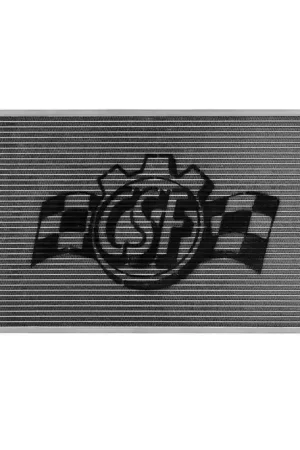
Must Have CSF Radiators 1-Row 31mm Ultra High Performance Aluminium Radiator(BRZ 12-21/86 22+)
Original price was: $639.00.$255.60Current price is: $255.60. Add to cart -
Sale!
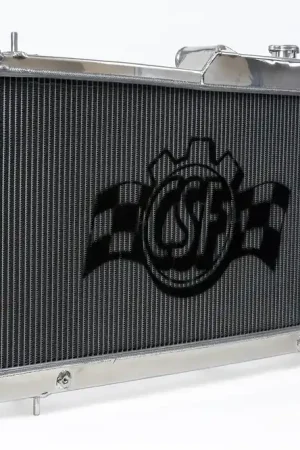
Low Price CSF Radiators 2-Row 42mm Race Spec Aluminium Radiator (Forester Inc XT SJ 13-18)
Original price was: $779.00.$311.60Current price is: $311.60. Add to cart -
Sale!
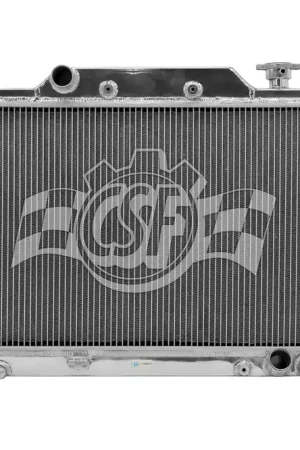
CSF Radiators 1-Row 31mm Ultra High Performance Aluminium Radiator (Civic Type-R EP3 01-05) Same Day Shipping
Original price was: $549.00.$219.60Current price is: $219.60. Add to cart -
Sale!
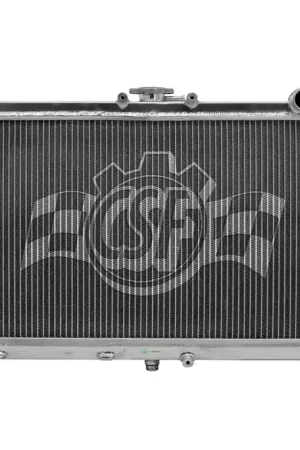
Trusted Brand CSF Radiators 2-Row 42mm Race Spec Aluminium Radiator (MX-5 NB 98-05)
Original price was: $589.00.$235.60Current price is: $235.60. Add to cart